Summer 25% discount on all last year's products home decor

Estimate how much fabric an order needs from piece dimensions, quantity, wastage, and usable fabric width.
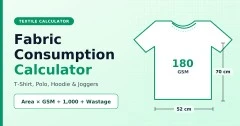
Introduction
Most buyers request a tech pack before asking what the garment weighs, which is backwards. I learned this on a men’s tee order, where one careless guess about fabric width cost us a whole week.
Everyone quotes a flat wastage number, yet I distrust it. Real marker efficiency swings with stripes, pockets, and big hoods, so a rough planning figure of 10–12% only starts the conversation, never truly ends it.
Knit cloth sold by weight genuinely surprised me early on in my career. Suppliers quote GSM, kg, and yarn, rarely metres, because stretch makes length unreliable, so I now check finishing before trusting any roll.
For a 150 pcs hoodie batch, I budget fabric per colour, since a separate dye lot never matches. Body and rib bought separately means the rib weight deserves its own line, not a rounding afterthought.
Small errors compound at scale: +10 cm of overconsumption per garment on a 10,000-unit order at $6/m burns 1,000 m and $6,000 of added cost, which no merchandiser ever forgives quietly during weekly review meetings.
How To Use The Fabric Consumption Calculator
Start with the piece length and piece width in centimetres. Enter the cut size of one piece including seam and hem allowance, because every extra cm shifts consumption per piece noticeably. For garments, I always set size M first, then check other sizes later.
Next, enter the quantity in pieces. Add the usable fabric width in cm, not the label width, since knit fabric arrives tubular or open, and that changes everything downstream entirely.
Then type the wastage allowance as a percentage, usually ten to twelve on simple knits, plus shrinkage if the yarn is not pre-shrunk. Leave waste guesses out; a factory cutting marker gives far truer numbers.
Press Calculate to read the net area, the area with wastage, and the fabric length in metres and yards. For knits sold by weight, multiply the area by GSM ÷ 1,000 to get kilos, so how much fabric per dozen answers itself.
Use Reset to clear every field and start a new run. Confirm width and GSM with the mill before costing, because Structure and GSM decide fibre requirements very quickly.
Formula: How Fabric Consumption Is Calculated
Net area (m²) = length × width × quantity ÷ 10,000
Area with wastage = net area × (1 + wastage %)
Fabric length (m) = area with wastage ÷ usable fabric width (m)
I have seen buyers skip the classic one-line formula and guess. Start with finished flat measurements: ½ chest, body length, sleeve length, then add width allowance and length allowance before touching wastage % at all.
A size-M tee at 180 GSM showed me why: each cut rectangle gets area, multiplied by GSM, divided by 10,000, giving grams. Front + back and sleeves stack up, while the neck rib (folded) joins.
Contrary to common belief, shrinkage matters less than cutting loss. At 87% marker efficiency, 13% of marker area disappears; counting length shrinkage on top risks double-counting, so I treat process loss separately in my sheet.
For joggers and hoodies, body + rib need separate weights: rib price per kg differs from fabric price per kg. A 320 GSM fleece/French terry body at 12% wastage feels very different from a polo.
Meanwhile, per dozen figures such as 2.48 kg per dozen help order quantity planning, yet per garment values like 0.207 kg per tee stay truer. Factory figures and mill advice should always override my defaults.
Worked Examples
500 pieces of 70 × 140 cm need 490 m² net. With 5% wastage that is 514.5 m². On 150 cm usable width, the fabric length is about 343 m (375.1 yd).
A medium tee in 180 GSM jersey weighs about 0.2 kg once 10% wastage is added, which surprises people expecting more. I always start there, because 1.1 m² of cloth sounds tiny until it multiplies.
Our 320 GSM fleece hoodie in size M weighs 0.68 kg: 0.61 kg body plus 0.07 kg rib, after 12% wastage. A lined hood has 4 panels instead of 2, so recheck the total area.
Scaling up, 150 hoodies need 103 kg, including 11 kg rib, while 150 tees need only 31 kg. Each colour hits the per-colour minimum separately, so plan each dye lot individually rather than simply pooling.
Take 1.8 m width and 3.9 m marker length: 7.02 m² marker area versus 5.5 m² pattern area means marker efficiency of 78%. Those 6 tees weigh 1.264 kg, so 0.211 kg per tee, body only.
Grading matters: 2.5 cm half chest, 2 cm body length and 1 cm sleeve and bicep shift S 0.192, M 0.207, L 0.223 and XL 0.239 kg. Weight by ratio, 1:2:2:1, gives 0.215 kg overall.
Typical Fabric Consumption By Garment
Typical figures are rough illustrations, not procurement specs. A basic T-shirt in 180 GSM single jersey needs roughly 1.1 metres at 150 cm width, while sweats and polos climb higher once collars and cuffs enter.
Take my own sample: a 200 GSM piqué polo, size M, weighs about 0.26 kg with 10% wastage. Multiply by twelve and you get roughly 3.1 kg per dozen, a simple number buyers understand instantly.
A long-sleeve tee and a sweatshirt in 300 GSM French terry/fleece show the jump: sleeves add length, heavier cloth adds grams, and garment weight roughly doubles compared with a plain summer tee in cotton jersey.
Check flat-knit pieces and polo collars and cuffs separately before quoting.
Wastage, Shrinkage & Process Loss
Wastage is rarely one number. I split it into marker waste, defects, end-of-roll loss and seam and hem allowance, then check whether the total added allowance stays inside a range the factory will realistically accept.
Fabric shrinkage runs 2–5% along length, while width shrinkage is closer to 2.3% after dyeing; pre-shrunk or compacted fabric lowers both, sometimes even down to 0 after proper finishing at a reliable and experienced mill.
Efficiency varies by size. I plan S 82%, M 86%, L 88%, XL 90% and 2XL+ 92%, with XS 78%, because bigger pieces nest better, and per-size marker efficiency lets overrides replace flat guesses entirely.
Consider 150 pcs of a 0.68 kg hoodie. Trimming 6 g per garment looks trivial, yet 0.9 kg disappears into recuts alone, and faults plus shade differences quietly consume the cloth between pieces as well.
Simple fixes: long lays and simple shapes help, while small orders, directional fabric and curves hurt. Cutting rectangles wastes less than pattern cut bigger than needed, and lay ends punish careless planning near 5–15% wastage.
Marker Efficiency & Bulk Booking (CAD)
In a factory, marker planning happens in CAD before any bulk cutting starts. The cutting room receives a CAD marker built from a graded pattern, and that file, not my spreadsheet, ultimately decides bulk consumption.
Here is the marker-based method in plain terms: marker length times fabric width gives marker area, pattern pieces nest inside, and dividing by garments in marker returns consumption per garment (m) before any extra allowances.
Typical efficiency lands in the high 70s to high 80s per cent for simple knit shapes, because the marker nests pieces around each other, though I always confirm the real width before quoting any buyer.
A booked figure should include end-of-roll waste, shade-band cutting and process loss, which are not in the marker. Early on, my pre-pattern estimate was always lower than the true bulk requirement, sometimes by several points.
Different size ratio splits shift the answer, so a marker covering all sizes needs its own share of cloth calculation. I check pattern area against efficiency and treat allowances as separate lines on every order.
Knit vs Woven: Weight-Based vs Marker-Based Method
Wovens such as cotton shirting, poplin, twill and denim are sold by metre or yard, and they hold dimensions well, so a marker-based method with software to minimise waste is the sensible route for them.
Knits flip the logic. Knitted jersey, rib, fleece, terry and piqué are sold by weight, quoted per kg, and loose structure makes width in finishing unpredictable, so weight-based method estimates usually win out in practice.
Weight route: area × GSM gives grams, and dyed cloth adds process loss. Yards and linear metres change with stretch, so I convert only length from a marker when a buyer genuinely insists on metres.
Mixed orders are common: a fleece hoodie with rib cuffs plus a denim jacket. Each needs its own consumption method, and I never blend width assumptions, since jersey tubes behave quite unlike flat wovens altogether.
Over time I noticed terry and piqué hide knits surprises: stretch, loop height, finishing. Whatever the metres, kg or yards you see on a quote, ask for the actual knitted weight, not a nominal figure.
Fabric Width, GSM & Kg ↔ Metres Conversion
For knit garments, Cotton Jersey (light) at 120–150 GSM fits summer tees, Cotton Jersey (standard) at 160–200 suits year-round tees, French Terry at 200–350 covers casual wear and most sweatshirts, and Fleece at 250–400 suits hoodies and joggers.
Metres per kg equals 1,000 ÷ (GSM × width in m), and kg per linear metre is GSM times width (m) divided by 1,000. Divide metres ÷ 0.9144 for yards; 1 oz/yd² equals 33.906 g/m².
Take body jersey at 160 GSM and 150 cm width: 0.24 kg per metre, so 30 kg gives 125 metres. For tubular fabric, twice the flat width applies, so measure the usable roll width first.
Cost Impact Of Consumption Errors
Small errors in consumption look harmless on paper. An under-ordering of just a few centimetres per piece forces a second purchase of extra fabric, and that is where costs quietly explode for small exporters especially.
Suppose a 10,000-unit order where each garment needs 10 cm more than planned. That is 1,000 m of extra fabric, about $6,000 at $6/m in rushed purchasing, plus freight, which no spreadsheet had budgeted for at all.
Delays compound the damage. Missed deadlines trigger penalty clauses, while split shipments annoy buyers, and stoppages on the cutting floor leave sewing lines idle, burning labour that nobody ever billed back to the buyer anyway.
Colour risk is subtler. Topping up late means shade-varying lots, because the second dye batch never matches the first, so the garments from one order carry visible and obvious differences that buyers often reject outright.
Fabric Per Dye Lot And The 150-Piece Minimum
A 150-per-style-per-colour minimum is common, and each colour gets its own lot. Two lots never match perfectly, so I plan the dye-lot size first and let the order total follow naturally, never the other way.
Try my sample: 150 hoodies in a 280 GSM fleece at 0.55 kg each need roughly 83 kg after wastage, while the 150 tees in a 160 GSM jersey need about 27 kg in total.
Because dye-lot size drives everything, I ask mills whether a 150 hoodies run can share a bath with another style. Usually it cannot, so own lot pricing applies and small colours pay a steep premium.
One more habit: I add the order total across all colours before negotiating, because a 150-per-style-per-colour minimum can quietly turn a 400 piece order into a four colour headache with unequal and awkward bath sizes.
Hence two lots never match, even from one mill, so I keep shade cards and approve lab dips early. Experience taught me that buyers forgive a slightly higher price faster than a visibly different sleeve.
Sources & Disclaimers
Conversions rely on yard = 0.9144 m, the definition maintained by NIST, while mass per area follows ASTM D3776. These anchors keep calculators honest, though real cloth rarely behaves exactly like a printed standards table.
A planning estimate from cut rectangles will usually be higher than a CAD marker result. That is acceptable, because planning needs a safe number, not a surprise discovered after mill booking has already been closed.
Treat knitted-garment consumption figures as estimates, never guarantees. For markers used in production, ask the supplier to verify against a fresh sample, because yarn lots and finishing change numbers between seasons and even between mills.
When a buyer insists on proof, send fabric to a certified lab or your own test lab and compare GSM, width and shrinkage. Numbers from there beat any online tool, mine included, without any doubt.
Always confirm critical specs before costing, especially width and GSM, because small differences multiply across thousands of pieces. This tool offers guidance, and the final responsibility remains with whoever finally signs the actual purchase order.
Note: This is an area-based estimate. Cutting layouts, pattern matching, and shrinkage can change real consumption, so treat it as a planning figure.
{
"@context": "https://schema.org",
"@type": "SoftwareApplication",
"@id": "https://terrytowelmanufacturers.com/textile-calculators/fabric-consumption/#software",
"name": "Fabric Consumption Calculator",
"url": "https://terrytowelmanufacturers.com/textile-calculators/fabric-consumption/",
"applicationCategory": "UtilitiesApplication",
"operatingSystem": "Any",
"description": "Free online fabric consumption calculator to estimate fabric requirements based on product dimensions, quantity and wastage percentage.",
"browserRequirements": "Requires JavaScript",
"offers": {
"@type": "Offer",
"price": "0",
"priceCurrency": "USD"
},
"isAccessibleForFree": true
}
Frequently Asked Questions
What wastage percentage should I use?
Use 10–12% as a planning figure for simple knit tops and bottoms. Add two or three points for matched stripes, pockets, big hoods or awkward shapes, and go lower for long lays and simple shapes. Replace it with the factory’s marker efficiency once available, and avoid a blanket 20%.
How much fabric does a T-shirt need?
A medium tee in 170 GSM jersey (70 cm long, 52 cm wide) needs about 0.97 m², roughly 0.18 kg after waste. At 220 GSM it climbs towards 2.8 kg per dozen. Count neck rib separately (a 2 cm band is about 9 g) and adjust for size mix.
How do I calculate fabric consumption for a hoodie?
Treat each piece (front/back, sleeves, hood, pouch pocket) as a rectangle and add the areas. Multiply total m² by GSM ÷ 1,000, so 1.62 m² at 300 GSM gives 0.486 kg. Weigh the rib separately (0.09 kg in this sample), then add about 10% wastage and multiply by quantity.
Why is knit fabric bought by the kilo?
Mills are charged for yarn consumed, so weight is the fair unit across knitting, dyeing and finishing. Knit width and stretch change during relaxation, which makes metres unreliable. A 200 GSM roll carries a quarter more yarn than a 160 GSM roll of the same length.
How do I convert kilos of knit fabric to metres or yards?
Divide 1,000 by the GSM to get m² per kg, so 200 GSM gives 5 m². Divide that by the open width, so 5 m² over 1.6 m is 3.125 linear metres. Divide metres by 0.9144 for yards (about 3.42 yd), and for tubular fabric double the flat width first. If a buyer quotes oz/yd², multiply by 33.906 to get g/m². Confirm width with the mill, since finishing can shift it.
Can I use this calculator for bulk fabric booking?
Use it for budgeting and planning, not final booking. Book from a CAD marker built on the graded pattern, the real fabric width and your size ratio. Then add end-of-roll waste, shade-band cutting and dyeing/finishing process loss, which together added 4–8% in the author’s bookings.
How much fabric do I need for 150 pieces?
Multiply per-garment consumption by quantity and add wastage. 150 hoodies in 320 GSM fleece at 0.72 kg each need about 108 kg, while 150 tees in 180 GSM jersey at 0.21 kg each need about 32 kg. If the order is split into colours, check the supplier’s lot rules and round the final figure up.
How do I work out consumption per garment from a marker?
Multiply marker width by length, then divide by garments in the marker. A 1.7 m × 3.6 m marker gives 6.12 m², which at 160 GSM weighs 0.98 kg, or about 0.163 kg per tee for six tees. Add 2–3% for end-of-roll and end-of-lay allowances, weight by size ratio, and calculate rib separately.
How do I calculate fabric for a whole size run, not just a medium?
Calculate each size separately and weight by order quantity. At a 1:2:2:1 split with weights of 0.19, 0.21, 0.22 and 0.24 kg, the average is 0.215 kg, so 150 pcs need about 32 kg, which is 4% above the medium alone. Each size up adds 2.5 cm to half chest, 2 cm to body length and 1 cm to sleeve. Recalculate rib for the smallest and largest sizes and interpolate between them.
Is this exact for cut-and-sew work?
No. It is an area-based estimate, and marker efficiency will affect actual usage.
Can I get the result in yards?
Yes, the result is shown in both meters and yards.