Summer 25% discount on all last year's products home decor

Introduction
Nobody plans to learn the yard until a fabric roll, a quilters pattern, or a stadium forces the switch to meters. The conversion factor sits quietly at 0.9144, and I memorized it many years ago.
Contrarian view: the imperial unit isn’t outdated, merely stubborn. The US still prices carpet and anything sold by the yard, while worldwide the metric system quietly handles everything else without any real complaint from anyone.
The meter began in 1793 as one ten-millionth of the distance from the equator to the North Pole; 1889 brought the international prototype bar, and 1983 finally locked it firmly to light in a vacuum.
On a 120 yd pitch, I once paced the length for a soccer coach, and the 109.73 m result surprised him. That example shows why a quick conversion beats guesswork, especially when contractors bill precisely.
Rather than manual math, a converter works in both directions, giving accurate results that follow international standards. Students, athletes, and fabric stores all lean on it because it genuinely saves time every single working day.
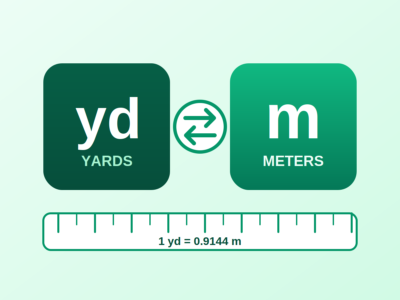
How to Convert Yards to Meters (Conversion Formula)
Skip the textbook order for a moment: 1 yd equals 0.9144 m, and that anchor never moves. Every other result flows from it, whether you are working with a tiny quantity or something truly enormous.
The working formula is m = yd × 0.9144, and its mirror is yd = m × 1.0936. Memorize one, derive the other, and you will never need to open a calculator for casual jobs.
Precision depends on how many decimals you keep. 1.0936 is fine for fabric, 1.09361 yd suits drafting, while 1.0936132983 yd belongs in engineering, and rounding too early makes results imprecise or approximately right at best.
Take 15 yd of curtain material: 15 yd × 0.9144 gives 13.716 m. Same story at 100 yd, which lands on 91.44 m, a figure many people wrongly round up to a full hundred meters.
That rounding creates an 8.56 m gap, and a 10 m difference appears if someone treats 100 yd loosely as 90 m. The difference matters; 1 m is 1.0936 yd, longer than a single yard.
Yard to Meter Conversion Examples
My favourite sanity check involves a 2.4 m ceiling: multiply by 1.0936 and you get 2.6247 yd. Contractors rarely say that aloud, yet it explains why standard plasterboard sheets feel oddly familiar in either unit.
Common Conversions I memorize: 1 yd is 0.9144 m, 5 yd is 4.572 m, and 10 yd is 9.144 m. Notice, though, how every answer simply shifts the decimal point of the original 0.9144 factor.
On the track, athletics commentators swap 100 yd for 91 m casually, though 91.44 m is exact. A 120-yard football field stretches roughly 109 meters, which often surprises visitors used to purely metric stadium layouts.
A 50 yd pool run equals 45.72 m, and 13.716 m matches 15 yd of rope. If you remember only those anchor values, scaling up or down becomes mental arithmetic instead of constant button pressing.
In practice I double-check every conversion against a second method, because tired eyes misplace decimals more often than any calculator ever will, and clients appreciate hearing about that habit upfront, wherever I happen to work.
Yard to Meter Conversion Table
A good conversion table saves more time than any app. I print one for every workshop wall, with a Yard column on the left and a Meter column beside it, nothing fancy at all, really.
| Yards (yd) | Meters (m) |
|---|---|
| 0.01 | 0.009144 |
| 0.1 | 0.09144 |
| 1 | 0.9144 |
| 2 | 1.8288 |
| 3 | 2.7432 |
| 5 | 4.572 |
| 10 | 9.144 |
| 20 | 18.288 |
| 50 | 45.72 |
| 100 | 91.44 |
| 1000 | 914.4 |
Start with the tiny entries: 0.01 yd becomes 0.009144 m, while 0.1 yd equals 0.09144 m. Those decimals look silly, but surveyors and model-makers lean on them daily, often without ever mentioning the numbers aloud.
Mid-range rows matter most for retail: 1 yd is 0.9144 m, 2 yd gives 1.8288 m, and 3 yd reaches 2.7432 m, which is roughly the height of a really tall doorway in older homes.
Moving upward, scan 5 yd at 4.572 m, 10 yd at 9.144 m, 20 yd at 18.288 m, and 50 yd at 45.72 m; those four rows cover most garden and sideline layouts I see.
Finally, 100 yd equals 91.44 m, and 1000 yd is 914.4 m. Because the table scales by powers of ten, one glance tells you whether a result looks plausible before you commit to ordering anything.
What Is a Yard (yd)?
Purists dislike admitting that the yard’s origin unclear status rests on legend. The Old English gerd meant a rod or waist girth, while folklore credits King Henry I with the outstretched thumb and nose measure.
In medieval England, merchants fixed 3 ft spans at 36 in, because fabric and textiles dominated trade. Even now, fabric and textiles dealers quietly cling to the yard stubbornly long after engineers moved on elsewhere.
The US customary unit is defined as exactly 0.9144 m since 1959, when countries agreed on one shared figure. Before that, the UK and America often disagreed by tiny but costly margins across big surveys.
Drive past UK road signs or watch cricket pitches at a quiet village green and the yard still persists. Cricket pitches measure 22 yards, while golf fairways and golf scoring lean heavily on yards constantly.
Beyond sports fields, American and Canadian football measures progress in yards, and American football scoreboards confirm it. Construction crews, landscaping teams, and land surveyors reuse distances in yards, especially short distances for easy mental math.
What Is a Meter (m)?
Few people realize the history of the meter begins with a metal bar: 90% platinum and 10% iridium, stored safely in a Paris vault. Later definitions abandoned alloys entirely, which still surprises most curious students.
Then came 1960, when the krypton-86 emission line, based on wavelengths of orange light, replaced the bar. Laboratories celebrated, though shopkeepers never noticed the change at all, because their tape measures still read as before.
The 2019 redefinition tied absolutely everything to 1/299,792,458 of a second, the exact time light needs in vacuum, giving the current definition of the SI base unit used worldwide in busy labs, workshops, and classrooms.
In daily life, roads, rooms, fabrics, and athletic tracks use 1 m as the base, with 100 cm inside it and 1,000 m making 1 km. Convenience, not elegance, truly explains its enduring worldwide popularity.
The US remains the exception, clinging to customary units in homes and shops while science, trade, and aviation went metric. Americans often pay for that split constantly, which is why converters even exist at all.
Are a Meter and a Yard the Same?
Short answer, no, but the difference hides in plain sight: a meter is slightly longer than a yard, and the 1.0936 yd result proves it. Many customers assume roughly the same and then move on.
Take a 120-yd field as an example: converting it gives 109.73 m, roughly ten meters shorter than a hundred and twenty meters. That gap decides whether a pitch plan fits the available lot, or not.
I once watched a coach laminate a field diagram in meters, then order turf by the yard; the mismatch cost real money. Unit habits, not math skills, usually cause such costly, avoidable mistakes on site.
Think of it this way: one meter beats one yard by about nine centimeters, a margin invisible on a ruler but obvious across a hundred repeated cuts of curtain fabric taken from one long roll.
So treat them as cousins, never twins. Round-trip any figure carefully through both formulas once, compare, and you will see why professionals keep conversion factors on sticky notes beside their measuring tapes at all times.
Metric vs. Imperial Systems
Historically the imperial family grew out of body parts and royal decrees, so 1 ft equals 12 in, while 1 yd equals 3 ft. Nothing about those ratios is accidental, yet nothing is decimal either.
Compare that with metric logic, where 10 mm make 1 cm, 100 cm make 1 m, and 1,000 m make 1 km. Everything snaps together by tens, which is why scientists never once looked back.
Bridge the two with one number, 0.9144 m, because that figure is the only official, legally recognized handshake between both systems. Everything else, from tape measures to blueprint scales, is simply derived from it quietly.
Imperial users cope through familiarity. Metric users cope through arithmetic. Neither group is smarter; they simply grew up with different rulers, and converters politely absorb all the friction between those two upbringings every single day.
In my own projects I standardize on one system per drawing, then convert only at the edges. That rule prevents mixed-unit disasters and keeps clients from questioning invoices after final delivery, saving everyone awkward emails.
Why Use Our Converter?
Most free converters feel clunky because they load ads before answers. Ours returns an instant result as you type, which matters when a supplier is waiting on the phone and your thumbs are busy elsewhere.
Being mobile-friendly was non-negotiable for me, since half my clients check measurements from a warehouse floor or a fabric aisle, not from a desktop in a tidy office with a keyboard and a second monitor.
US measurements deserve respect too. Plenty of American buyers think in yards, feet, and inches, so the interface speaks their language first, then offers the metric equivalent right alongside, without lecturing anybody about it, ever.
Accuracy comes from fixed constants, not rounding tricks. I tested the tool against printed tables and a long steel tape, and the numbers matched within the decimals that tailors, builders, and coaches actually care about.
Finally, simplicity wins repeat visits. No signup, no clutter, no jargon, just two boxes and a swap button, which is exactly what you want when the fabric cutter is waiting impatiently at the busy counter.
Practical Applications of Yard to Meter Conversion
Take turf estimates: a local landscaper quoting in yards of sod must still report meters to a supplier overseas. I have seen quotes double-checked three separate times simply because nobody trusted the original imperial label.
Global athletics governs tracks in meters, while American football and youth sports fields around schools still chalk lines in yards. Coaches working in landscaping or routine field maintenance end up speaking both dialects quite fluently.
Then there is sewing: international patterns ship in meters, US fabric stores sell by the yard, and home improvement carpet remnants complicate everything further. One mismatch and a whole weekend of metric cutting goes wrong.
Fencing projects teach humility. Posts spaced at 2.4 m intervals sound neat until a yard-based roll of wire finally arrives, forcing quick mental math to avoid costly leftovers or embarrassing gaps between neighbouring fence panels.
In every single case, the practical lesson is identical: decide which unit your supplier thinks in, convert once, label everything clearly, and keep the original numbers beside the converted ones for easy auditing much later.
Fabric Shopping Angle
Fabric aisles are where this topic bites hardest. Roll labels in meters, price tags printed per yard, and sudden doubts about how much is truly enough make nervous fabric buyers reach for their phones midway.
Curtain buyers face the worst of it. Add pleats, hems, and pattern repeats, and a curtain order for one large window can swing by a full yard depending on the unit in the fine print.
Weekend DIY projects, whether cushions, tablecloths, or throw blankets, deserve the same care. A good converter instantly removes guesswork, because buying too little means a second frustrating trip and buying too much means lingering regret.
My rule: add ten percent for pattern matching, then convert. Doing it in that order, not the reverse, keeps rounding errors small and ensures the cutter hears one clean number rather than three separate ones.
Sample cards, meter-wide rolls, and yard-wide bolts all circulate in the same busy shops. Ask for the cut length in the unit printed on the roll, then quickly verify with the converter before paying anything.
How Do I Convert 100 Yards to Meters?
Start with 100 yards and multiply by 0.9144 to get 91.44 m. That single line answers the question, and it is the same arithmetic every busy sports broadcaster and fabric supplier performs behind the scenes.
Going backward here, meters to yards works by multiplying by 1.0936, which turns the 91.44 you just obtained earlier into roughly one hundred again, confirming that nothing slipped during the first calculation or rounding step.
Why does this matter? Because meters appear on international tracks while yards appear on American fields, and a hundred of either unit looks nearly identical on a scoreboard but differs by almost nine whole meters.
In practice, I tell clients: first convert the figure, then check it against a known landmark. A sprint of 100 yards feels shorter than a hundred-meter dash, and your result should agree with that instinct.
Finally, save the pair of constants somewhere handy and visible: 0.9144 one way, 1.0936 the other. Round-trip every important number, record both versions in your notes, and nobody will ever seriously question your measurements again.
How Many Meters Are in 25 Yards?
Asking how many meters sit inside 25 yards is common among backyard pool owners and archers. The answer is 22.86 m, obtained by 25 × 0.9144, and it fits neatly inside a standard suburban garden.
To reverse the calculation, multiply that 22.86 by 1.0936, which returns almost exactly twenty-five yards. That loop is my favourite quality check because it exposes typos instantly, before any expensive material gets cut or ordered.
Beyond pools, twenty-five yards also shows up in archery ranges, fencing runs, and short garden paths. Converting each into meters helps contractors, who usually draw their plans in metric, avoid costly confusion at final handover.
Rounding deserves a word: 22.86 m is exact because the factor is exact, so there is nothing to approximate. Rounded to 23 meters you lose fourteen centimeters, which is fine for lawn but not joinery.
Anyone buying edging, rope, or hose for a 25-yard stretch should always round up, never down, and keep the converted figure written on a receipt. Leftover material is usually cheap; a missing meter is not.
Are One Meter and One Yard the Same Length?
No, one meter and one yard are not the same length, although casual speech blurs them together. The meter wins by a very small margin that quietly adds up across larger projects and longer rolls.
In numbers, a meter is slightly longer, measuring 1.0936 yd, so the meter exceeds a yard by roughly three and a half inches. That is invisible at a glance but expensive across a warehouse order.
People say about a yard when they mean a meter. I hear it at hardware counters constantly, and each time I point out that the shortfall becomes noticeable once you order sixty or seventy units.
Think of a classroom demonstration: hold a meter stick beside a yardstick and the extra length stands out. Students remember that visual long after formulas fade, which is why teachers keep both tools on hand.
So the honest, practical summary is simple. Treat them as very close cousins, never interchangeable, and let the converter quietly handle the gap whenever precision matters for tailoring, flooring, planting, or any outdoor sports layout.
Hands-On Experience With Yard and Meter Conversions
My earliest conversion mishap involved a hand-sewn banner ordered for a school fair. I quoted yards, the printer heard meters, and the finished fabric arrived short, teaching me to confirm units aloud before any deposit.
Over several years of building websites for local shops, I noticed customers typed measurements with every punctuation style. Handling commas, decimals, and stray spaces gracefully became more important than any design element on the page.
Watching tailors work taught me another lesson: experienced hands estimate in body lengths, then verify with a tape. The yard survives precisely because arm span is an intuitive reference, even though meters win in calculation.
Coaches taught me the third lesson. Marking a field in yards then ordering paint by liter confuses crews, so I now ask for one unit system on every single sheet, signed off before work begins.
Finally, my YouTube editing habits shaped how I explain numbers: show the result first, the method second, and a quick visual check third. Viewers forgive slow intros less than they forgive rounding, in my experience.
Expert Insights for Avoiding Conversion Errors
The single most common error is swapping the factor: multiplying by 1.0936 when you should multiply by 0.9144. A quick plausibility rule really helps; yards should always convert to a noticeably smaller number of meters.
Second, watch for hidden unit mixing in spreadsheets. A column labeled length might contain yards in just one row and meters in another, and no formula can rescue data that never stated its units clearly.
Third, rounding policy matters far more than tools. Decide once whether you round at each step or only at the end, document it clearly, and apply it consistently so repeated conversions never quietly drift apart.
Fourth, remember context. Fabric allowances, shrinkage, and pattern repeats change how much you buy, while conversion only changes how you label it. Never let a suspiciously clean number convince you the plan is truly complete.
Last, simply trust but verify. Cross-check against a physical tape measure, keep a printed reference card near your workspace, and treat every online result, including mine, as a second opinion rather than a final authority.